

Integrated circuits engineered for elevated temperatures.
Harmonie Design Labs develops custom integrated circuits for systems that must operate reliably at temperatures beyond the practical limits of standard semiconductor components.
Our high-temperature IC design capability covers the complete development path, from operating-profile analysis and technology selection through circuit implementation, verification, tape-out coordination, and silicon characterization.
Each project is developed around its actual operating environment. Temperature range, exposure duration, duty cycle, electrical conditions, packaging constraints, and expected product lifetime are considered from the beginning of the design process.
- Operating-environment and temperature-profile analysis
- High-temperature ASIC architecture
- Semiconductor process and technology assessment
- Temperature-aware circuit design
- Reliability-oriented design methodology
- Design verification across operating conditions
- Packaging and assembly coordination
- High-temperature silicon characterization

High-temperature performance begins at architecture level
Designing an integrated circuit for elevated temperatures requires more than extending the qualification range of a conventional design.
As temperature increases, device behaviour, leakage, timing, electrical margins, material performance, and long-term reliability can change significantly. These effects must be considered during architecture, implementation, verification, and physical design.
Harmonie Design Labs evaluates the complete operating profile before defining the IC architecture. This allows temperature-related risks to be addressed as part of the design rather than treated as a final-stage testing problem.
Define the Operating Profile
We evaluate the required temperature range, exposure duration, duty cycle, supply conditions, interfaces, performance targets, packaging environment, and expected product lifetime.These requirements are translated into design constraints, technology criteria, verification conditions, and validation objectives.
Design for Temperature
The architecture and circuit implementation are developed around the target operating environment. Device behaviour, electrical margins, timing variation, leakage, physical implementation, and long-term degradation mechanisms are considered throughout the design process.Design reviews are performed against the approved operating profile rather than nominal laboratory conditions alone.
Characterize and Validate
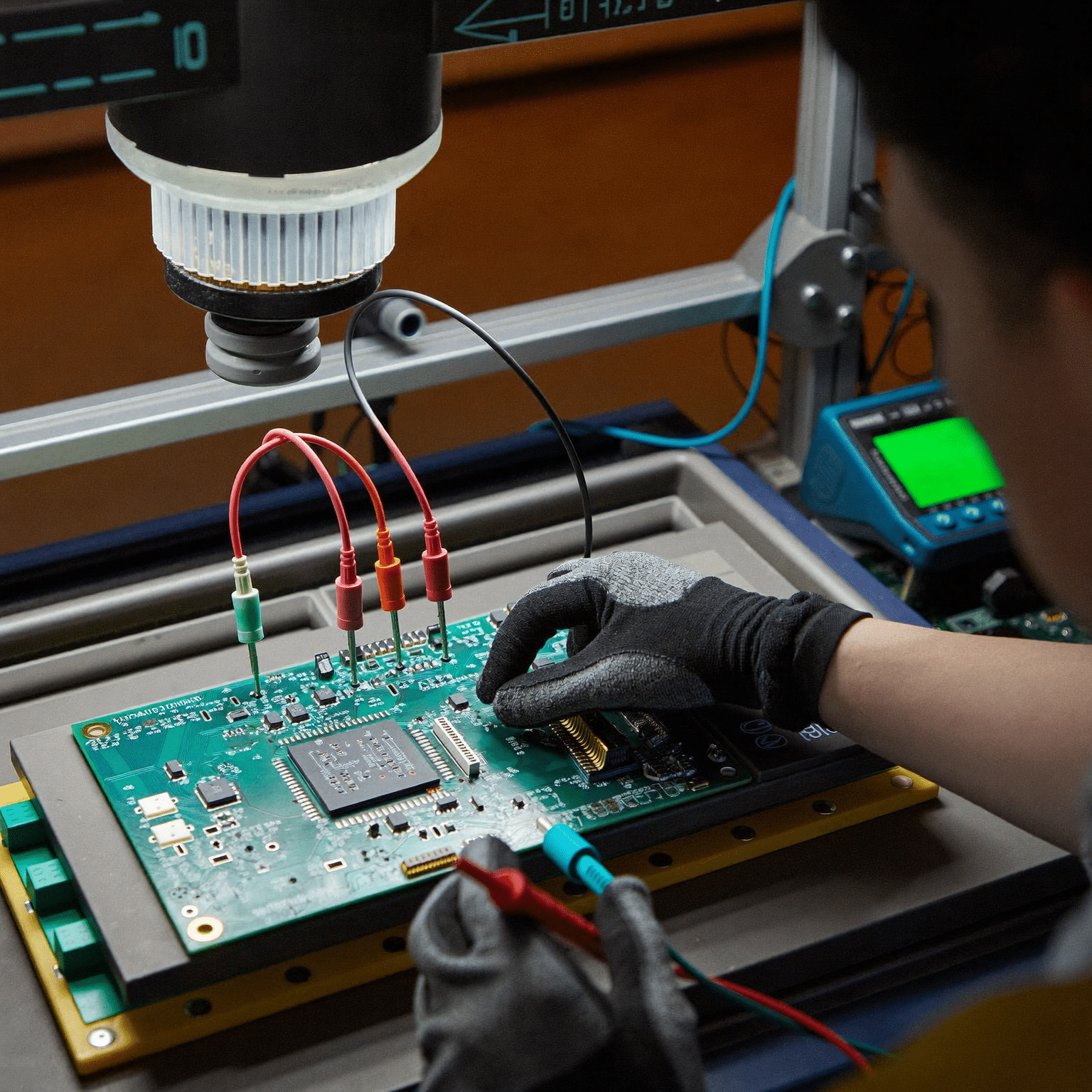
Following tape-out and first-silicon bring-up, the IC is evaluated across the required temperature and electrical conditions.Measured results are compared with the specification to assess functionality, performance, stability, and available operating margin. Findings are documented to support the next development or production stage.
Why Standard Components Reach Their Limits
Commercial semiconductor components are designed and qualified for defined operating ranges. Outside those ranges, functionality alone is not enough to establish reliable performance.
Using a standard component outside its qualified conditions may create unpredictable performance and reliability risks.
A custom high-temperature IC allows the circuit architecture, semiconductor technology, physical implementation, and validation program to be developed around the actual application environment.
Elevated temperatures can affect:
- Leakage current and static power consumption
- Device threshold and switching behaviour
- Timing margins and clock performance
- Electrical accuracy and signal stability
- Interconnect and material reliability
- Packaging, bonding, and assembly materials
Applications
High-temperature IC design may be required in systems where electronic components operate close to a heat source, inside a restricted enclosure, or in environments where cooling is limited or unavailable.
The required design approach depends on more than the maximum temperature. Exposure time, thermal cycling, vibration, supply variation, packaging, and expected operating lifetime must also be considered.
Typical application areas include:
- Downhole and drilling instrumentation
- Oil and gas measurement systems
- Mining and underground electronics
- Geothermal monitoring systems
- Industrial sensing and control
- High-temperature measurement equipment
- Harsh-environment sensor systems
- Near-engine and underhood electronic systems
Frequently asked questions
Most of our high-temperature work targets ambient operation in the 175 °C class. Higher is reachable depending on process, package and required lifetime. The limiting factor is rarely the transistor itself — it is leakage, drift, package stress and the accumulated effect of thousands of hours at temperature. We define the target from your operating profile rather than from a peak number.
No. A custom high-temperature design may also be appropriate at lower temperatures when the application requires improved stability, longer operating life, specific functionality, or performance beyond available standard components.
Possibly, but the feasibility depends on the original architecture, semiconductor process, available design margins, physical implementation, and packaging. In some cases, selected sections can be modified. In others, a new architecture is the more reliable path.
We support packaging and assembly discussions as part of the overall development process and can coordinate technical requirements with qualified manufacturing and packaging partners. Final package selection depends on the operating profile and application environment.
Validation may include functional testing, electrical characterization, timing measurements, and stability assessment across the specified temperature and supply conditions. The final test plan is defined according to the IC specification and intended application.
Yes. High-temperature design is a primary area of expertise, but Harmonie Design Labs also develops custom ASICs for standard operating environments.